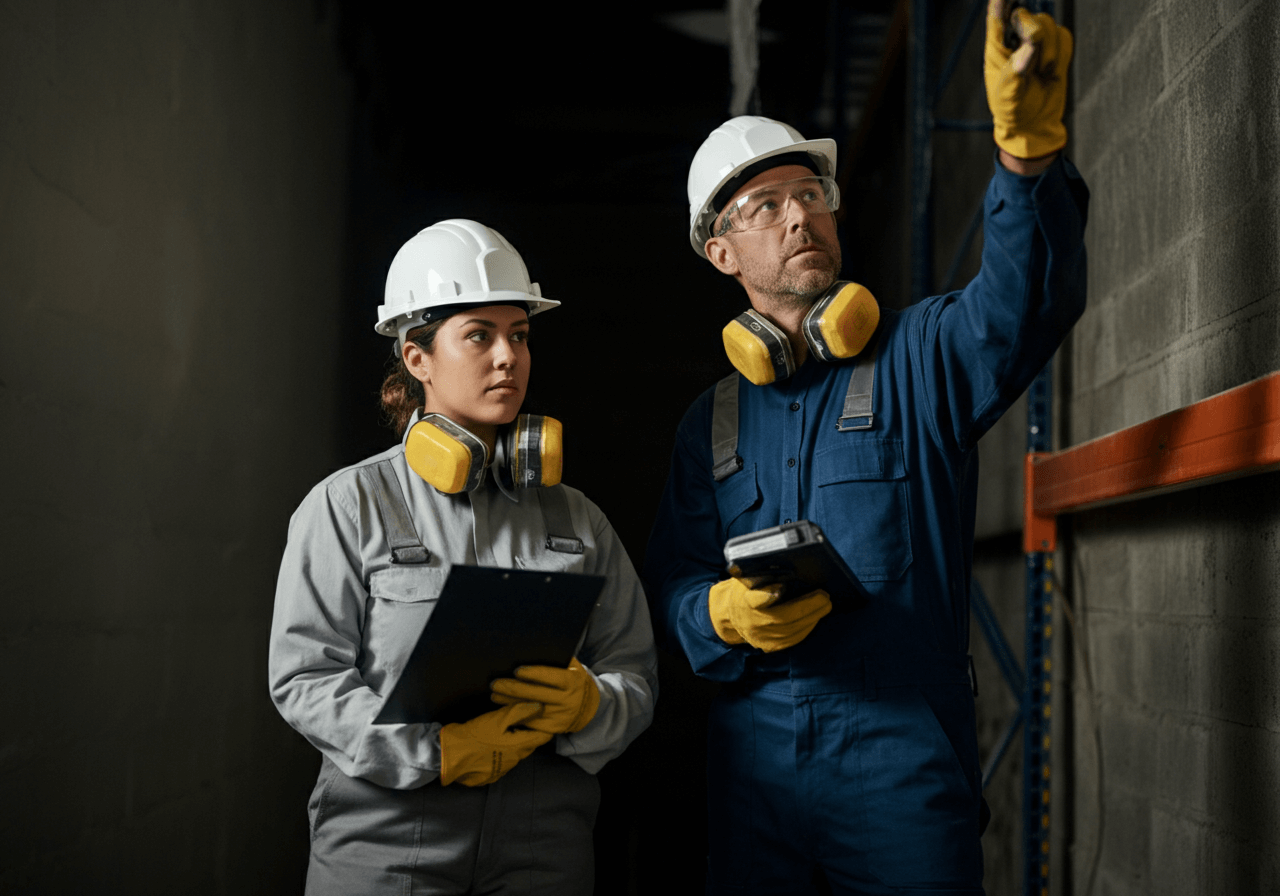
You’re on site, midway through a job, and something doesn’t feel right. The material you’ve uncovered looks older than expected. Slightly fibrous. Out of place for what you thought you’d find.
That hesitation matters.
Knowing how to identify asbestos is not about making a definitive call on the spot. It is about recognising when a material could contain asbestos and responding in a way that keeps people safe and meets your legal obligations.
This guide focuses on practical asbestos identification, what asbestos looks like, where it is commonly found, and what to do next if you come across it at work.
What is asbestos and why it still matters on site
Asbestos is a group of six naturally occurring mineral fibres, most commonly chrysotile, amosite and crocidolite in Australian buildings. Here is a useful refresher on fibre types and how they differ.
Although banned in 2003, asbestos remains present in many existing structures. The risk is not the material itself when it is undisturbed. The risk arises when work activities disturb asbestos-containing materials (ACMs) and release fibres into the air.
This makes asbestos a live risk on any site involving maintenance, renovation or demolition. Tasks that seem routine, such as cutting into walls, lifting old flooring or accessing ceiling spaces, can disturb materials that have been stable for decades.
Safe Work Australia’s Model Code of Practice: How to Manage and Control Asbestos in the Workplace outlines how asbestos risks must be identified and managed. These requirements sit alongside the Work Health and Safety Regulations 2017 (Cth) and relevant state-based legislation.
For PCBUs, this forms part of the broader duty to identify hazards, assess risks and implement controls before work begins. Asbestos is one of the hazards where those expectations are particularly explicit because of the consequences of exposure.
Safe Work Australia’s Model Code of Practice: How to Manage and Control Asbestos in the Workplace sets out clear expectations for PCBUs. This includes identifying asbestos or assuming its presence where uncertain, maintaining an asbestos register, implementing an asbestos management plan, ensuring information is accessible to workers, and reviewing control measures whenever work or conditions change
Where asbestos is commonly found
If you are trying to identify asbestos, location is often your most reliable starting point.
Common asbestos-containing materials include roofing and external materials such as corrugated cement sheets, roof flashing, gutters and fencing panels. Inside buildings, asbestos may be present in wall sheeting, partitions, eaves, soffits and ceiling tiles. It is also commonly found in internal linings in bathrooms and laundries.
Flooring can include asbestos in vinyl tiles, backing materials and adhesives. In services and infrastructure, asbestos may be present in pipe insulation, flue pipes, switchboard backing boards and electrical meter panels. Surface finishes such as textured coatings, sealants and adhesives may also contain asbestos.
In commercial and industrial environments, asbestos is often found in plant rooms, service ducts, lift shafts and older mechanical systems. These are areas that are not accessed frequently, which increases the likelihood that asbestos will only be encountered once work begins.
These materials are often concealed behind newer finishes or located in areas that are only accessed during upgrades or repair work. Because of this, asbestos is frequently encountered unexpectedly rather than identified upfront. Here’s a guide to typical asbestos locations.
Friable vs non friable asbestos
Once asbestos is suspected, understanding the type of material is critical.
Friable asbestos can be crumbled or reduced to powder by hand and releases fibres easily into the air. It is commonly found in insulation, pipe lagging and sprayed coatings and represents the highest risk category.
Non friable asbestos is bonded within solid materials such as cement or vinyl. It presents a lower risk when intact but becomes hazardous when cut, drilled, sanded or broken.
This distinction directly affects how asbestos must be managed under the Work Health and Safety Regulations. Friable asbestos must always be handled and removed by a licensed asbestos removalist. Non friable asbestos may only be handled without a licence under strict conditions and below specific thresholds.
In practice, this means that once a bonded material is disturbed, its risk profile changes. A task that begins as low risk can quickly become high risk if the material is cut or broken.
What does asbestos look like in practice
There is no single visual profile for asbestos. Identification relies on recognising a combination of material type, condition, location and age, but asbestos fibres themselves are microscopic and cannot be confirmed by sight alone. Materials that look harmless can still contain asbestos, which is why assumptions based on appearance alone are risky. Under WHS Regulation 419, limited work involving asbestos is permitted for the purposes of identification and sampling, as well as maintenance of non-friable asbestos installed before 2003. This work must be carried out by a competent person and in a way that minimises the release of airborne fibres.
1. Common material types
Flat cement sheeting is one of the most common asbestos products and is often used in internal walls, ceilings and external cladding. Corrugated cement sheets are typically used in roofing and sheds. Backing boards behind switchboards and meter boxes are another frequent source.
2. Surface characteristics
Asbestos-containing materials often have a dense, cement-like appearance with slightly dimpled or pitted surfaces. Fibrous strands may be visible at broken edges, and some sheet products show a layered internal structure.
3. Location clues
Eaves and soffits in older homes, internal linings uncovered during renovation, vinyl tiles in commercial spaces and insulation around older pipe systems are all common indicators.
4. Product markings and context
Some materials include stamps such as AC for asbestos cement. These can support identification but are not always present. If a material is original to a building constructed before the asbestos ban, the likelihood increases significantly. Go here for more context on age and identification.
5. Where identification can go wrong
Misidentification often happens because materials are layered, painted or partially replaced. A newer surface can conceal an older asbestos-containing product underneath. In renovation work, it is common to encounter mixed materials where only part of a structure has been upgraded.
Modern fibre cement products can also look almost identical to asbestos-containing materials. This makes visual judgement unreliable, particularly when materials are intact. Because of this, identification should always be treated as a trigger for further action, not a final decision.
One of the most common scenarios on site is uncovering a material that looks consistent across a surface, only to find that sections have been patched or replaced at different times. This creates a mix of asbestos-containing and non-asbestos materials in the same area. Without clear documentation, it is not possible to distinguish between them visually. This is why any uncertainty should be treated conservatively. If there is a reasonable chance that asbestos is present, work should stop and the material should be assessed properly before proceeding.
Asbestos testing and who can carry it out
If asbestos is suspected, testing must be controlled and carried out by qualified professionals.
Sampling should be performed by licensed asbestos removalists, licensed asbestos assessors or occupational hygienists. Testing must be conducted by a NATA-accredited laboratory.
Bulk sampling involves collecting a small section of material to confirm whether asbestos is present and, where relevant, the type of asbestos fibre. Air monitoring is used to detect airborne fibres, particularly where disturbance has occurred or during removal work. Clearance inspections combine visual checks and air monitoring to confirm an area is safe to reoccupy.
Uncontrolled sampling is one of the most common causes of exposure. Workers should never attempt to take samples themselves, even if the material appears low risk.
What to do if you encounter asbestos at work
Identifying asbestos is only useful if it leads to the right action.
For workers
Stop work immediately, do not disturb the material, isolate the area, report the issue to your supervisor or PCBU and follow the asbestos management plan. Document the location and condition of the material if safe to do so.
For PCBUs
Secure the area, review the asbestos register, engage a licensed assessor, update the management plan and determine whether removal is required.
More than 10 square metres of non-friable asbestos requires a licensed removalist, while friable asbestos must always be removed by a licensed contractor. Certain removal work must also be notified to the regulator before it begins.
Here’s more practical guidance on managing asbestos risks in the workplace and the cost considerations.
Where asbestos is confirmed, work planning needs to be revisited before any task resumes. This may involve sequencing work differently, isolating areas for removal, or coordinating licensed contractors before other trades return to site. Treating asbestos as a standalone issue often leads to disruption later. Integrating it into the overall work plan early reduces delays and ensures compliance is maintained throughout the project.
Be aware that requirements vary between jurisdictions. Most states and territories operate under the harmonised WHS framework, while Victoria operates under the Occupational Health and Safety Act, which affects licensing and regulatory processes.
Asbestos registers and workplace obligations
For many workplaces built before 2004, an asbestos register is required.
The register must identify asbestos-containing materials, record their location and condition, be kept up to date and be accessible to workers and contractors. It must be reviewed before any work begins.
An asbestos management plan must also be in place where asbestos is identified or assumed. This plan outlines how risks are controlled, how work is carried out safely and how incidents are managed.
The register must identify known or assumed asbestos-containing materials, record their location and condition, be kept up to date and be accessible to workers and contractors. It must be reviewed before any work that could disturb asbestos begins.
These systems are central to compliance and ensure that asbestos risks are managed consistently rather than reactively.
What to do if you suspect asbestos at home
For homeowners, the priority is avoiding disturbance and engaging qualified professionals.
Leave the material in place, do not cut or drill into it, contact a licensed asbestos assessor, arrange testing through a NATA-accredited laboratory and use a licensed removalist if required.
Even small renovation projects can create exposure risks if asbestos is present.
Unlike workplaces, homeowners are not subject to the same WHS legislative duties. However, the risks associated with disturbing asbestos are the same, which is why a cautious, do-not-disturb approach is still essential.
Is asbestos awareness training required
If workers may encounter asbestos, training is required under WHS legislation.
This applies to electricians, plumbers, carpenters, demolition workers, HVAC installers, construction workers and anyone entering ceiling or roof spaces.
The 11084NAT asbestos awareness course covers identification, risks and safe work practices.
You can also read more about the health impacts of asbestos.
Those moving into removal work should check out this training and licensing pathways.
In the ACT, additional requirements apply. Electricians and plumbers must complete 11348NAT asbestos awareness training before carrying out relevant work.
Bringing it back to the job
Asbestos identification is not about certainty. It is about recognising risk early and responding correctly.
If a material looks suspicious, assume it could contain asbestos. Stop work, avoid disturbance and follow the correct process.
For workplaces, this means meeting legal obligations, maintaining asbestos registers and ensuring workers are trained.
Handled properly, asbestos can be managed safely. The risk comes from overlooking it or disturbing it without the right controls in place.